Inside Verus's Three-Mode Pipeline (spec, proof, exec)
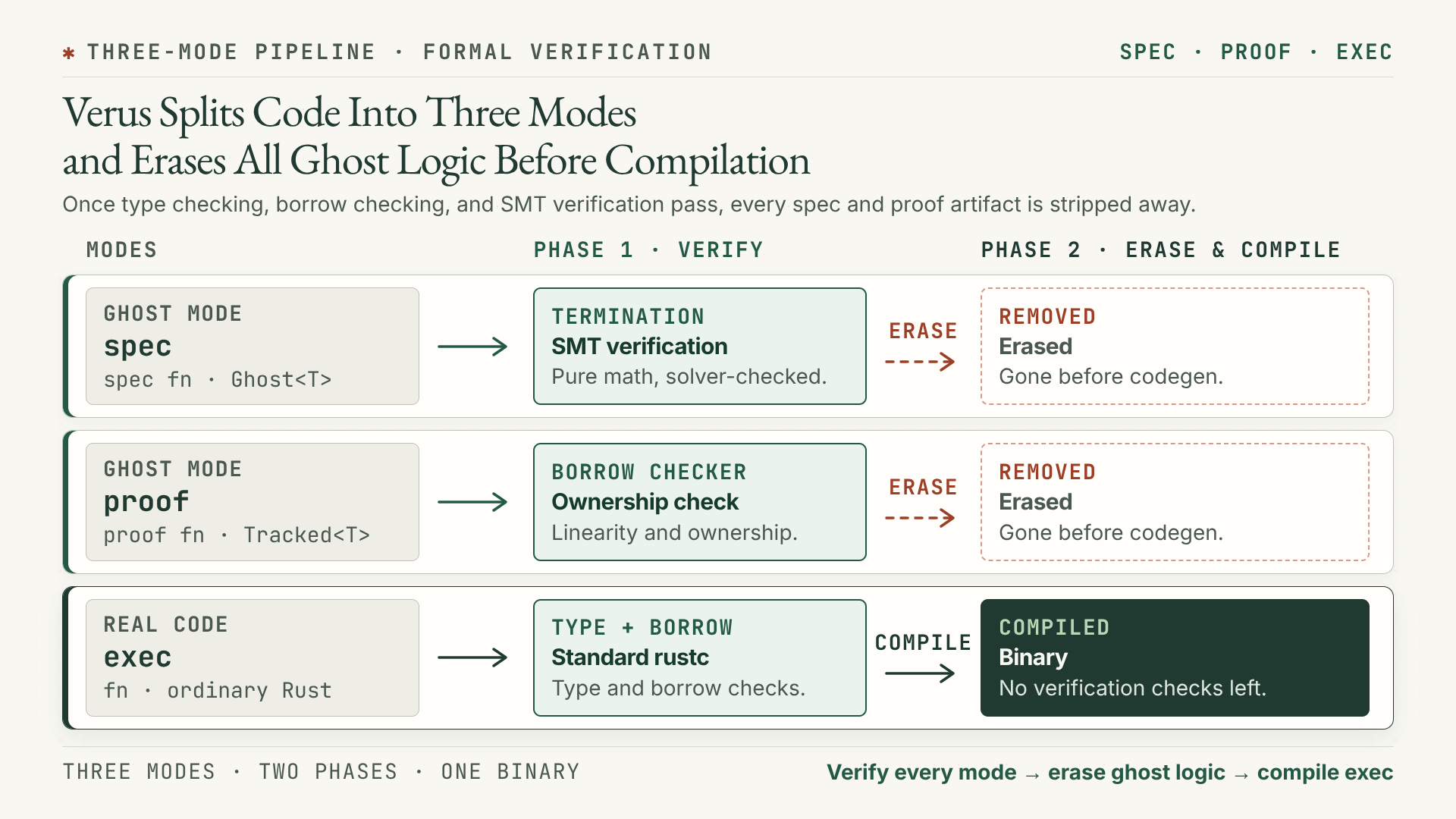
Verus checks spec, proof and exec code in three modes, then erases the ghost logic before the binary is compiled.
How does Verus verify low-level systems code—raw pointers, interior mutability, and concurrency—with zero runtime cost?
It partitions every function and variable into three strict modes:
- spec mode (spec fn, Ghost<T>): Pure, deterministic math (requires / ensures). Checked for termination, erased before codegen.
- proof mode (proof fn, Tracked<T>): Ghost code checked by Rust's borrow checker for linearity and ownership.
- exec mode (fn): Ordinary executable Rust.
Once type checking, borrow checking, and SMT verification pass, Verus strips away every spec and proof artifact. Your compiled binary ships with zero verification checks attached.
Clean mental model. Zero runtime tax.
#RustLang #Verus #SystemsEngineering #FormalVerification