Verus's Secret Weapon: Trusting Rust's Own Borrow Checker
The borrow checker already provides strong semantics that helps reduce the work on proofs that Verus needs to verify
Why is Verus making formal verification practical for real Rust systems when older tools struggled?
One architectural insight: Verus refuses to rebuild separation logic from scratch.
Because safe Rust already enforces aliasing-XOR-mutability, Verus trusts rustc's borrow checker. Immutable references (&T) and owned pointers (Box, Rc, Arc) are encoded directly as mathematical values of type T in the SMT solver, rather than modeling raw heap locations and framing rules manually.
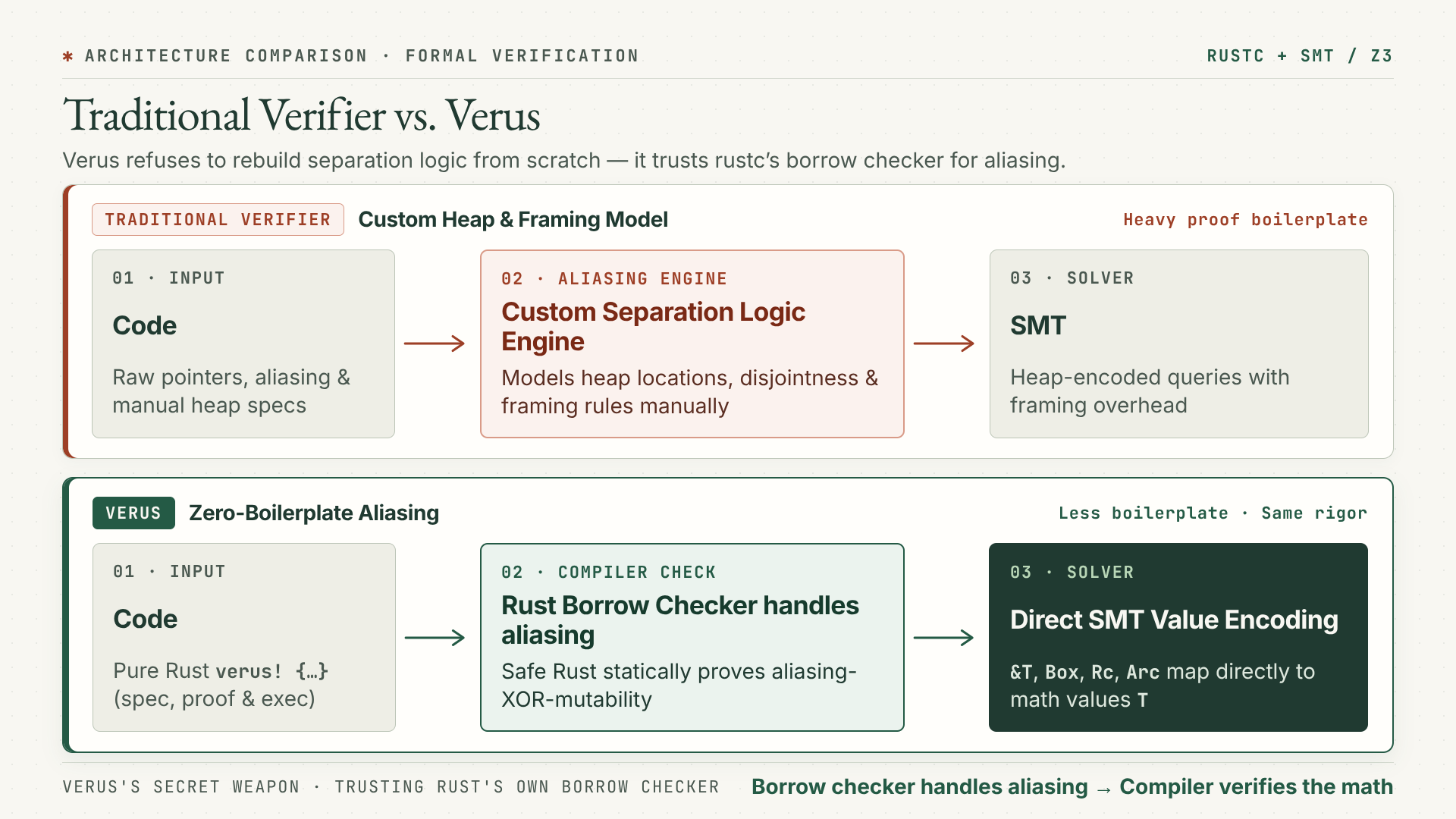
You write specs, proofs, and executable code in pure Rust syntax inside verus! { ... } blocks, and the compiler verifies the math while the borrow checker handles aliasing.
Less proof boilerplate. Same mathematical rigor.
Which goes to show that the borrow checker offers more than meets the eye, its rules, despite being stricter than they have to be, offer better ergonomics and safety guarantees. Sounds a lot like the performance offered by the aligned MOVes in the x86 CPU architecture that all has acquire/release semantics, stricter than it has to be, but offers a robust and performant architecture.
Have you tried writing specs inside a systems language instead of an external proof assistant like Coq or Dafny?
#RustLang #Verus #FormalMethods #Compilers